• Mathematics

    The book of nature is written in the language of Mathematic. -Galileo

  • Physics

    We live in a universe that responds to what we believe. -Corbin Henry

  • Chemistry

    We define organic chemistry as the chemistry of carbon compounds. -August Kekule

  • Astronomy

    The universe is like a safe to which there is a combination, but the combination is locked up in the safe. –Peter de Vries

  • Engineering

    There’s nothing I believe in more strongly than getting young people interested in science and engineering, for a better tomorrow, for all humankind. -Bill Nye

Measuring density lab experiment

When scientists talk about how much something weighs, they usually talk about its mass rather than its weight. Scientifically, you should use the word weight only when talking about the force gravity exerts on a particular object. So density is not the weight bust the mass of 1 cubic centimeter of the substance. Water, for instance, has a density of 1 gram per cubic centimeter. Gases are very light and have low densities - water is almost 1,000 times as dense as air. Most solids, however, are much denser than water. Gold, for example, is almost 20 times as dense as water.

A block of iron weighs more than a block of wood the same size, iron is said to be denser than wood. Every substance has its own density, which is how much a certain amount of it weighs. This experiment shows how to work out the density of different solid. 

Thins you will need:

1. A plastic bottle

2. A measuring cup

3. A knife

4. A scale

5. Some graph papers

6. A plastic tube


Instruction

1. Cut the top off a plastic bottle, make a hole a little way down, and fix the tube in with modeling clay, making the seal as watertight as you can

2. Put a container under the spout, and fill the bottle with water until it pours out of the spout. Now select the object to be measured

3. Place an empty measuring cup under the spout, and immerse the object fully in the bottle. Note how much water spills into the cup.

4. Take the object from the water, dry it, and weigh it. To calculate the density, divide the weight by the volume of water in the cup.

5. Your project should look similar to the picture below when done.


Uniform Motion along a Straight Line

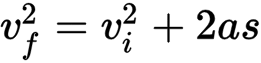
This represents an important situation. In this case, the acceleration vector is constant and lies along the line of the displacement vector, so that the directions of v and a can be specified with plus and minus signs. If we represent the displacement by s (positive) if in the positive direction, and negative if in the negative direction), then the motion can be described with the five equations for the uniformly accelerated motion:


Direction is important, and a positive direction must be chosen when analyzing motion along a line. Either direction may be chosen as positive. If a displacement, velocity, or acceleration is in the opposite direction, it must be taken as negative.

Uniformly Accelerated Motion

Speed is a scalar quantity. If an object takes a time interval t to travel a distance d, then average speed is equal to the total distance traveled divided by time taken:


Or


Here the distance is the total (along the path) length traveled. Velocity is a vector quantity. If an object undergoes a vector displacement, s, in a time interval, t, then average velocity is equal to vector displacement divided by time


Or 

The direction of the velocity vector is the same as that of the displacement vector. The units of velocity (and speed) are those of distance divided by time, such as m/s or km/h.

Acceleration also a vector quantity, measures the time-rate-of-change of velocity:


Where Vi is the initial velocity, Vf, is the final velocity, and t is the time interval over which the change occurred. The units of acceleration are those of velocity divided by time. A typical example is (m/s)/s or ms^2 )

Parallelogram Method for Vector Addition and Subtraction

Parallelogram Method for Vector Addition 

The resultant of two vectors acting on any angle may be represented by the diagonal of a parallelogram. The two vectors are drawn as the sides of the parallelogram and the resultant is its diagonal, as shown below. The direction of the resultant is away from the origin of the two vectors.


Component Method for Vector Addition

Each vector is resolved into its x-, y-, and z-components, with negatively directed components taken as negative. The scalar x-component, Rx, of resultant R is the algebraic sum of all the scalar components. The scalar y- and z-components of the resultant are found in a similar way. With components know, the magnitude for the resultant is given by


In two dimensions, the angle of the resultant with the x-axis can be found from the relation


Vector Subtraction

To subtract a vector B from a vector A, reverse the direction of B and add individually to vector A, that is 


Graphical Addition of Vectors (Polygon Method)

Note: Whenever you see A, B, C or R in a sentence that means I am referring to the symbols below


This method for finding the resultant R of several vectors

(A, B, C consists in the beginning at any convenient point and drawing (to scale and in the proper directions) each vector arrow in turn. They may be taken in order of succession.


The tail end of each arrow is positioned at the tip end of the preceding one, as shown below.


The resultant is represented by an arrow with its tail end at the starting point and its tip end at the tip of the last vector added. If R is the resultant, R = |R| is the size or magnitude of the resultant.